Imagine a modern-day Pompeii, not a relic of ancient history, but a ghost town frozen in the late 20th century, suffocated by ash, yet still eerily present. Plymouth, Montserrat's former capital, isn't just a destination; it’s an unsettling, perfectly preserved time capsule, abandoned in a matter of hours after a cataclysmic volcanic eruption in 1995. You’re not just seeing ruins; you’re witnessing half-buried 90s cars, office buildings with filing cabinets still inside, and homes where everyday objects remain entombed in twenty feet of gray mud, all within a permanent "exclusion zone" that redefines 'off-the-beaten-path' Caribbean travel.
Getting to Montserrat itself is an exercise in intentional travel, sidestepping the mass tourism routes. You’ll typically fly into Antigua (ANU), then catch a short, scenic twenty-minute hop via a small prop plane. It’s an investment, both in time and money—figure around $150-$200 for the Montserrat leg alone, on top of your US flight, which can range from four to seven hours depending on your departure city. As you descend, the lush green northern part of the island gives way to the stark, ash-covered south, a dramatic topographical contrast that smacks you with the reality of the Soufrière Hills volcano’s power. This isn't your typical beach resort arrival; it's a quiet acknowledgement of nature's dominance.
Accessing the Plymouth exclusion zone isn't a casual stroll; it requires a licensed local guide and often a permit, a necessary measure for safety and to respect the island's ongoing recovery. Expect to pay anywhere from $75-$150 for a half-day tour, depending on the guide and the depth of the exploration. This isn't a place for DIY adventurers to cut corners; the terrain is unpredictable, and active volcanic monitoring is constant. Your guide isn't just a storyteller; they're your lifeline, navigating the shifting landscape and explaining the nuanced dangers of the "Danger Zone" vs. "Daytime Entry Zone."
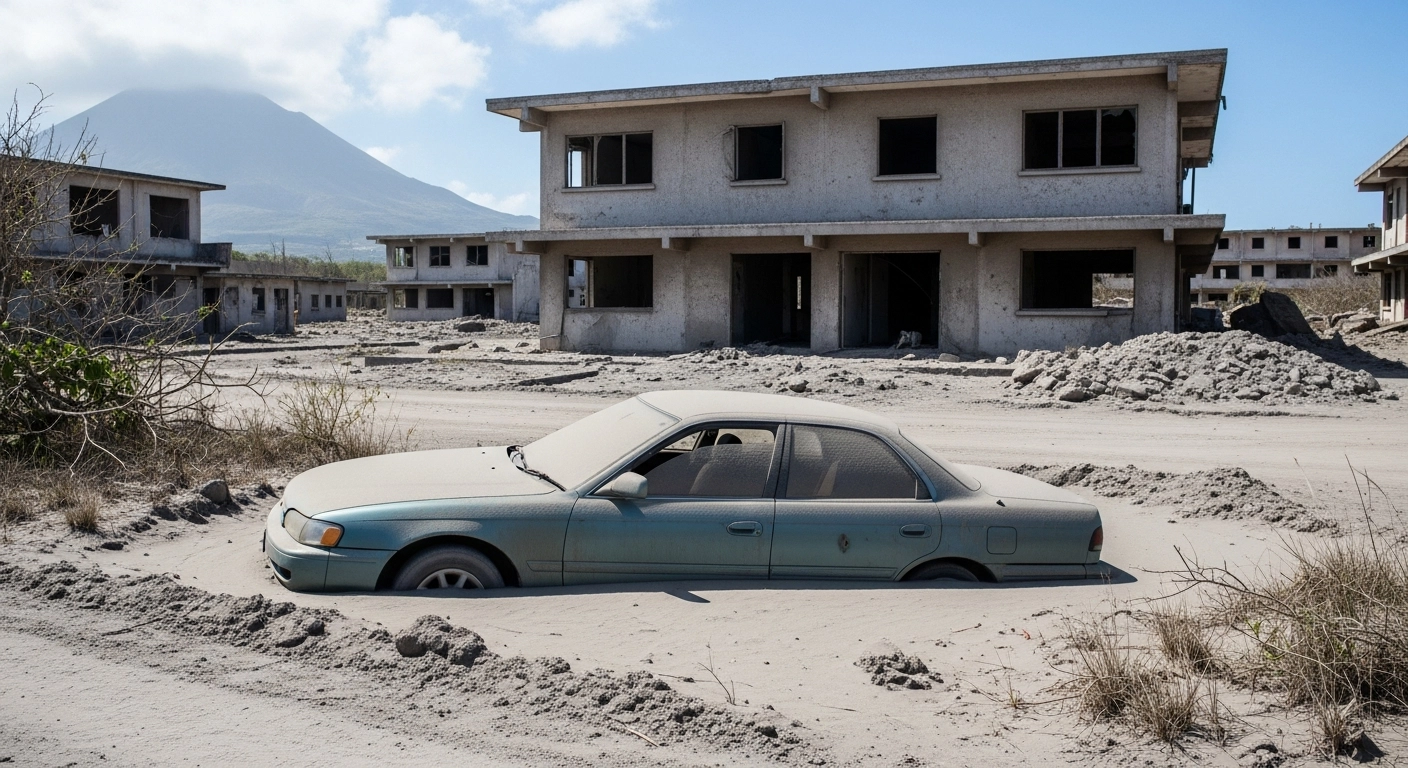
Once inside, the sheer scale of the devastation and the surreal preservation hits you. You’re not just looking at a historical site; you're peering into office windows caked with ash, seeing desks still arranged, calendars stuck on September 1997. Cars from the era, like a Toyota Tercel or a Nissan Sunny, are entombed up to their windshields, their colors muted by a thick coating of grey, perfectly preserved ghosts of the Caribbean road. This isn't Pompeii with its grand villas; it’s the mundane, everyday life of a small Caribbean capital, frozen mid-century modern, amplifying the tragedy. You’ll walk past what was once the airport, now a runway buried under volcanic flows, a stark testament to the island's forced evolution.
Beyond the immediate ghostly city, a truly unique experience lies in visiting the Montserrat Volcano Observatory (MVO) or designated viewpoints on the northern side. From here, you gain a panoramic, yet safe, perspective of the active Soufrière Hills volcano, often still emitting steam or ash plumes. This isn't a thrill ride; it’s a scientific marvel, an opportunity to witness raw geological power. The MVO often has information panels explaining the history and ongoing monitoring, providing a rational, scientific counterpoint to the emotional impact of Plymouth. Seeing the source of the destruction from a safe distance helps contextualize the silence below, highlighting the ongoing dance between creation and destruction.
For a stark contrast, spend time in Little Bay, the island's burgeoning interim capital. Here, life slowly rebuilds. You’ll find new government buildings, small restaurants serving fresh seafood, and locals gathering at the jetty. It’s a powerful testament to Montserratians' resilience, a vibrant, living answer to Plymouth’s static grief. Enjoying a humble plate of goat water (a local stew) here, perhaps at a small, unassuming eatery like 'The Attic,' not only supports the local economy but offers a glimpse into the island’s hopeful future, a direct counterpoint to the past frozen in ash. This contrast is key to understanding the full narrative of Montserrat.
Budgeting for Montserrat means being realistic about its remote nature. To save money, consider staying in a guesthouse or apartment rental rather than a resort—these often offer kitchenettes, allowing you to self-cater and save on restaurant meals, which can be pricier due to import costs. Groceries are available but don't expect supermarket variety or bargain prices, given the island's size and logistical challenges. Public transport is minimal, so factor in taxi costs or the rental of a small car, which offers more flexibility for exploring the accessible parts of the island. A pitfall to avoid is showing up without prior arrangements for the exclusion zone; guides are few, and their schedules fill up quickly, making spontaneous tours nearly impossible. Always book your tour in advance.
Visiting between March and June offers optimal conditions. The hurricane season hasn't typically begun in earnest, meaning clearer skies and less rain, which is crucial for navigating ash-covered roads and enjoying outdoor exploration. Crowds are virtually non-existent year-round, so you won't encounter 'peak season' price hikes for the unique experience Plymouth offers, though flights to Antigua might see slight fluctuations. The weather is consistently warm, allowing for comfortable exploration without the oppressive humidity of later summer months. From the US, plan for a full day of travel to get there, and remember that local infrastructure is developing, so patience and flexibility are your best companions, along with a healthy dose of adventurous spirit.
Ultimately, a trip to Plymouth isn't just about seeing a buried city; it's about confronting the raw power of nature, understanding human resilience, and experiencing a chapter of modern history unlike any other Caribbean destination. It debunks the myth that the Caribbean is solely about pristine beaches and rum punches; here, the allure is in the profound silence, the ash-laden memories, and the quiet awe of a capital city that dared to defy complete disappearance. This isn’t just a vacation; it’s an education, a poignant reminder that even paradise can hold unspeakable secrets, waiting patiently for you to uncover them.