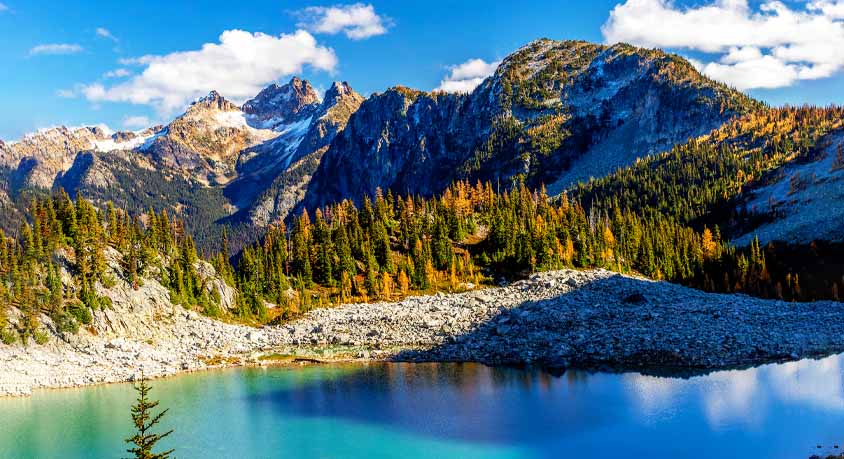
The silence at 5,000 feet isn’t actually silent; it’s a low-frequency hum of wind brushing against ancient granite and the distant, rhythmic drip of a melting glacier. I stood on a rocky outcropping near Sahale Arm, the pre-dawn light turning the jagged peaks of the North Cascades into a sea of bruised purple and gold, holding a lukewarm tin cup of coffee that felt like luxury. There wasn't a single permit-check line, no idling shuttle buses, and definitely no family of six arguing over a selfie stick.
Just as the sun cracked the horizon, a mountain goat trotted past my boots with a look of pure indifference, its hooves clicking softly on the shale. It occurred to me then that while half of Washington was currently suffocating in a three-hour traffic jam just to enter Mount Rainier, I had found a parallel universe that felt like the Swiss Alps, minus the $50 fondues and the crowds.
Driving three hours north of Seattle into the jagged heart of the "American Alps" is a masterclass in psychological warfare against your own GPS. The North Cascades National Park is free—zero dollars for entry—which is a hilarious contrast to the $30 fees and reservation systems clogging up the more "famous" parks nearby. I bypassed the shiny, tourist-trap lodges in the gateway towns where a "rustic" burger will set you back $25 plus tip. Instead, I stocked up at a local grocery store in Concrete, a town that looks exactly how it sounds, and found that a $10 bag of local apples and some sharp cheddar tasted infinitely better when eaten on a log overlooking the electric-blue waters of Diablo Lake. The park’s sheer lack of commercial development means you aren't constantly being milked for "commemorative" keychains; you're just there with the trees.
Finding a place to sleep is surprisingly doable if you stop looking for thread counts and start looking for proximity. I skipped the overpriced "resorts" in Winthrop and opted for a small, no-frills guesthouse in Marblemount that cost me $130 a night, including a breakfast that actually involved eggs from a bird I could see from the window. The owner, a guy named Pete with a beard that could house several small mammals, laughed when I asked about "hidden fees." He told me, "The only fee here is the one you pay in sweat getting up Cascade Pass." For the budget-conscious, the park’s campgrounds are cheap, but the real win is the abundance of National Forest land surrounding the park where dispersed camping is often free, provided you don't mind the lack of a heated towel rack.
Stepping onto the Hidden Lake Lookout trail is where the "minimalist" façade of the park turns into a high-stakes endurance test. While everyone else is fighting for a parking spot at the Space Needle, I spent my afternoon hauling myself up 3,000 feet of vertical gain to reach a tiny wooden shack perched on a needle of rock. This isn't a groomed boardwalk; it's a raw, lung-burning scramble through wildflower meadows that look like a fever dream from "The Sound of Music." The lookout is free to use on a first-come, first-served basis for overnight stays, offering a million-dollar view of the jagged horizon for the price of a very sore set of quads.
Navigating the North Cascades Highway between April and July is a lesson in patience and layers. Most people fly into Sea-Tac from the East Coast—a solid six-hour flight—expecting a temperate Washington spring, only to find that the "American Alps" are still very much in the grip of winter's ghost. I watched a guy in flip-flops try to hike toward Rainy Lake in May, only to turn back when the slush reached his ankles. You have to understand that the snow lingers here like an unwanted houseguest; I found myself post-holing through white drifts in June while the valley below was a balmy 75 degrees. The payoff for this seasonal confusion is the waterfalls—thousands of them, fueled by the melting snow, screaming down the cliffs in a way that makes the "monumental" falls in other parks look like leaky faucets.
Choosing the right time to visit is the difference between a serene mountain retreat and a mud-caked survival exercise. I recommend hitting the trails in late June or July if you want to see the emerald lakes without a layer of ice, though the mosquitoes at that time are basically the park’s unofficial air force. Prices for flights into Seattle stay relatively stable until the mid-summer rush, but the real cost-saving happens on the ground. By using a fuel-efficient rental and avoiding the "scenic" tourist cafes, I managed to do a four-day deep dive into the wilderness for less than what most people spend on a single day at a theme park.