The alley off Charoenkrung Road looks like countless others in old Bangkok: tangled power lines overhead, faded shop signs in Thai script, the distant clatter of a street food cart. But halfway down, a cluster of young Thais with cameras and notebooks disappears through an unmarked doorway into what was once a storage facility for imported goods. This is Warehouse 30, a complex of World War II-era warehouses transformed into Bangkok's most understated creative hub. The assumption, reasonable given Bangkok's reputation for chaotic markets and glitzy malls, is that anything called a "creative district" must be a gentrified, overpriced playground for wealthy expats. I arrived expecting $8 lattes and $200 handcrafted notebooks sold by people who wouldn't meet your eye. What I found, by simply pushing through that unmarked door, was a living, breathing community of Thai artists and designers who seem almost annoyed when tourists find them—and charge prices that would make a street vendor nod in approval.
The moment you step into the main warehouse space, the financial reality of Warehouse 30 rewrites your Bangkok budget. A cold beer from the casual cafe tucked in the corner costs 80 baht, about $2.50. A pour-over coffee from the specialty roaster, made with beans from northern Thailand, runs 90 baht, less than $3. For that price in a hipster American coffee shop, you'd get a lukewarm drip coffee served by a barista with better tattoos than conversation.
Here, you get a meticulously crafted drink and a seat in a space where the industrial past—original concrete floors, weathered brick walls, steel beams stamped with 1940s manufacturing dates—has been preserved rather than polished. For a proper meal, skip the warehouse's small food counter and walk five minutes to the Charoenkrung Soi 28 street food cluster, where a grandmother has been making the same boat noodles for forty years. A steaming bowl costs 40 baht, $1.20, and the broth is rich with pork blood and secret spices that no Michelin-starred restaurant could replicate. Three bowls and a Thai iced tea later, you've spent less than $5 and eaten like a Bangkok local who works in the neighborhood.
For accommodation, the surrounding Charoenkrung area is old Bangkok at its most authentic—which means hotels range from backpacker hostels at $10 a night to the legendary Mandarin Oriental at $600. The savvy mid-range play is a small boutique hotel like the Arun Residence or Loy La Long, where $50-$70 secures a room with river views and character that chain hotels couldn't manufacture. The same $70 in a mid-sized American city might get you a generic motel room off the highway; here, it buys you a century-old wooden house converted into a hotel, with breakfast included and a canalside terrace where you can watch long-tail boats putter past while you eat your morning mango and sticky rice.
Transportation to Warehouse 30 rewards those who understand Bangkok's public transit logic. The BTS Skytrain's Saphan Taksin station is the nearest rail link, from which a short taxi or tuk-tuk ride costs 50-60 baht. But the real local move is the Chao Phraya River taxi: take the orange flag boat to Si Phraya pier for 15 baht (40 cents), then walk the ten minutes through the charmingly chaotic streets of old Charoenkrung. This walk alone, past gold shops, Chinese shophouses, and street vendors grilling squid on charcoal, is worth more than any overpriced guided tour. The hidden cost to avoid is the tuk-tuk driver who offers to "take you to the good warehouse" for 200 baht. There's only one Warehouse 30, and the meter taxi from Saphan Taksin should cost no more than 50 baht.
While the weekend crowds browse the main gallery spaces, the real soul of Warehouse 30 hides in its peripheral corners. Tucked at the back of Warehouse C, a narrow staircase leads to a mezzanine level where a collective of young Thai textile artists shares studio space. On any given weekday, you'll find them at workbenches, hand-dyeing fabrics with indigo, stitching experimental garments, or simply napping on floor cushions between projects. They don't sell to tourists; they sell to Bangkok's serious fashion insiders, and watching them work feels like glimpsing the future of Thai design without the gallery markup. In the smallest warehouse, a doorway barely marked leads to a tiny cinema space that screens experimental Thai films on Wednesday afternoons.
The films are often untranslated, the seats are salvaged theater chairs with questionable springs, and the audience consists entirely of art students who've cut class. Admission is free, and the experience of watching a Thai director's meditation on urban loneliness while surrounded by young Bangkok's creative class is worth far more than the zero baht it costs. Outside, the courtyard between warehouses hosts a rotating cast of food trucks on weekends, but the real find is the permanent vendor at the alley's entrance who sells grilled pork skewers for 10 baht each, marinated in a sweet-savory sauce that draws office workers from blocks away.
For a completely different perspective, walk five minutes to the historic Prince Theatre, now converted into a hostel and bar, where the rooftop offers panoramic views of the Charoenkrung neighborhood at sunset. A cold beer costs 80 baht, and the view of crumbling shophouses merging with modern condos, all bathed in gold light, is the kind of Bangkok that doesn't appear on postcards.
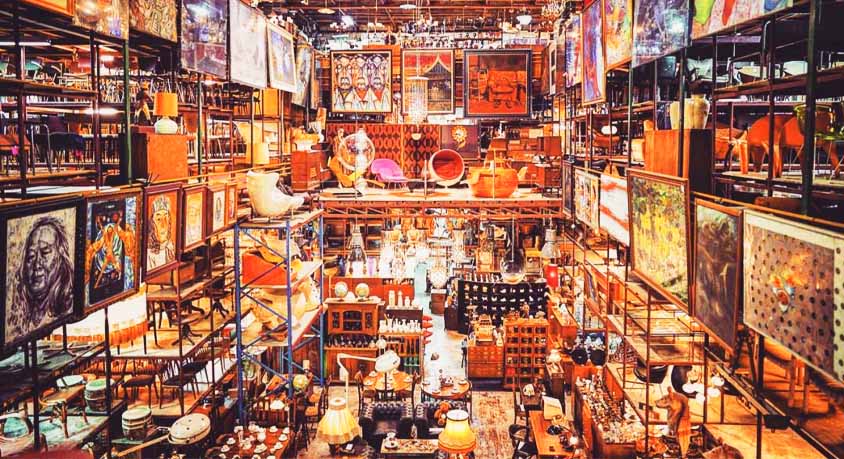
Finally, don't miss the small vintage market that materializes in the warehouse parking lot on the last Sunday of each month. This isn't a tourist market; it's where Bangkok's young designers and vintage collectors sell their finds—1950s Thai movie posters, mid-century furniture from old Bangkok families, handmade ceramics from local potters. Prices are negotiable, and the conversations with sellers reveal more about contemporary Bangkok than any museum exhibit.
Planning a visit between March and June requires navigating Bangkok's seasonal extremes with strategy. March is the furnace month, with temperatures hitting 95°F and humidity that makes walking between warehouses feel like wading through soup. The warehouses themselves, with their thick concrete walls and high ceilings, offer surprising respite—they were built to store goods before air conditioning, and their passive cooling design actually works. Visit in the late afternoon when the worst heat has broken, and you'll find the spaces comfortably cool compared to the street.
April brings Songkran, the Thai New Year water festival, when Bangkok essentially becomes a week-long water fight. Charoenkrung's narrow streets become particularly lively, with locals splashing from every doorway. The warehouses mostly close during the festival's peak days, so plan accordingly.
May and June mark the rainy season's onset, with afternoon downpours that arrive with dependable timing around 3 p.m. The warehouses' covered interiors and covered walkways between them make this an ideal rainy-day destination—you can explore for hours without touching an umbrella. The rain also keeps crowds thin, and the sound of water pounding on old tin roofs adds an atmospheric soundtrack to gallery browsing.
Your major cost is the flight into Suvarnabhumi Airport (BKK). From there, the Airport Rail Link connects to the BTS Skytrain for about $1.50, making the journey to Saphan Taksin efficient and affordable. Pack clothing that respects Bangkok's heat but covers enough for air-conditioned galleries—light linen or cotton, a scarf for temple visits if you detour, and shoes you can slip on and off easily. The Warehouse 30 aesthetic is effortlessly cool, but no one cares what you're wearing except you.